
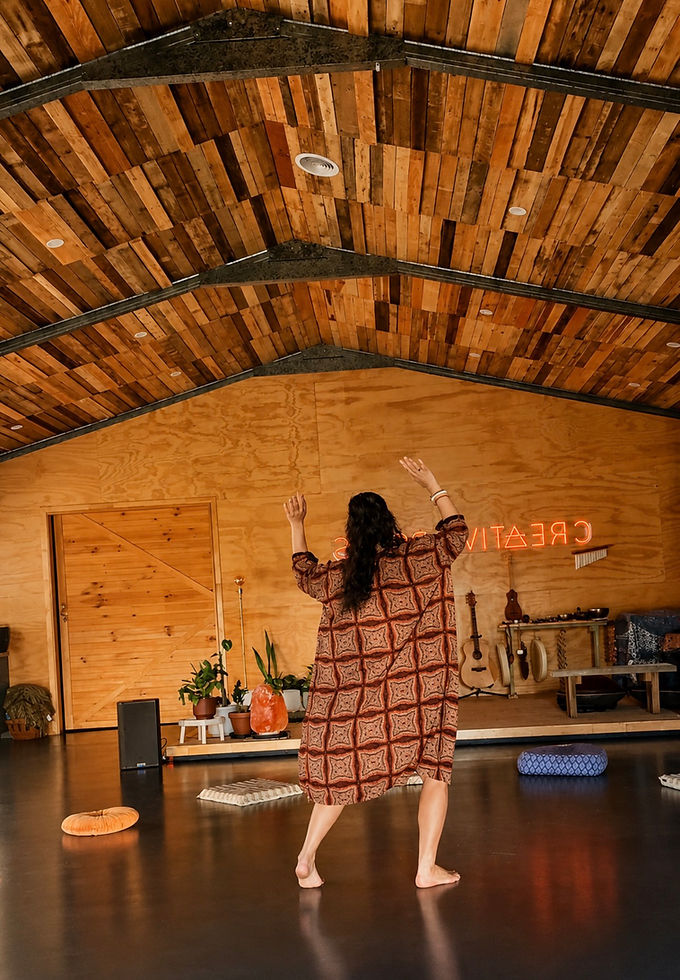
Cacao, Ecstatic Dance and Remembering the Body
There are some practices that don’t just become part of your routine.
They change the way you meet yourself.
For me, cacao has been one of those practices.
Since shifting from coffee to cacao, I have felt such a deep change in my body, my energy and the way I connect with the present moment. Coffee used to give me a certain kind of drive, but cacao has offered me something different. Something softer. Something more grounded. Something that feels less like pushing through life and more like arriving into it.
Cacao has become a beautiful tool for gratitude.
Not the polished kind of gratitude that skips over what hurts, but the quieter kind.. The kind that lives in the body. The kind that helps you pause long enough to notice the breath, the warmth in your hands, the people beside you, the earth beneath you and the simple gift of being here.
Science may not speak about cacao in the same way ceremony does, but it does offer some interesting insight. Cacao contains naturally occurring compounds, including flavanols and theobromine, which have been studied for their potential effects on brain function, blood flow, mood and cognitive performance (Nehlig, 2013; Scholey & Owen, 2013; Martín et al., 2020).
Research into cocoa and cocoa flavanols has shown promising links with cognitive function, cerebral blood flow, mood and mental performance, offering a scientific glimpse into why cacao can feel so supportive for presence, clarity and emotional connection (Nehlig, 2013; Scholey & Owen, 2013; Martín et al., 2020).
But anyone who has sat with ceremonial cacao knows there is more happening than chemistry alone.
There is intention.
There is slowness.
There is the act of preparing something with reverence, drinking it with presence and allowing yourself to listen inwardly.
And then, when Cacao is paired with Ecstatic dance, something powerful begins to unfold.
Ecstatic dance is not about looking good. Thank God, because most of us have spent enough of our lives performing already.
It is about expression.
It is about letting the body move before the mind can judge it.
It is about allowing joy to return through the hips, grief to move through the chest, playfulness to come back into the feet, and freedom to rise from somewhere much older than words.
Since beginning this movement practice, I have felt a huge shift in the way I connect with myself. There is a joy that comes through when the body is allowed to move freely.
Not choreographed.
Not controlled.
Just honest.
And that honesty is medicine.
The growing body of evidence around dance, movement and wellbeing reflects what many of us feel in the body. A large meta-analysis found that dance movement therapy and dance-based interventions may reduce depression and anxiety while supporting quality of life, interpersonal skills and cognitive functioning (Koch et al., 2019). Studies exploring conscious dance also suggest that participants often report benefits such as reduced stress, emotional processing, mindfulness, connection and psychological wellbeing (Laird et al., 2021).
This makes sense to me.
Because the body remembers.
And sometimes the body needs a way to speak.
Recently, this became deeply personal for me.
On Friday 5.06.26, my grandmother’s sister passed away. It was a tender time and I had already planned to co-facilitate our Cacao and Ecstatic dance evening alongside Mat.
But Mat, knowing what I was carrying, gently put his hand up to hold the whole workshop. He wanted me to have the space to be fully present with my own experience, rather than holding the space for everyone else.
That act alone was such a gift.
It allowed me to arrive not as the facilitator, but as a woman. As a granddaughter. As someone grieving, remembering, feeling and honouring.
During the dance, I felt myself drop into something much deeper than movement. It was as though my body became a place of remembrance, not just for my own grief, but for the women who came before me.
At one point, I felt the energy of both my maternal grandmother and her older sister, both now passed. I felt the women who came before me. The women who carried life, grief, strength, silence, sacrifice, love and survival in their bones.
I felt the women who had woven the path so that I could be here.
So that I could dance.
So that I could express.
So that I could move freely in a way perhaps they never fully had the chance to.
There was a deep reverence in that moment. A remembering of lineage. A feeling of being held by something much bigger than myself.
And this is what I love about these spaces.
They are not just “events.”
They are not just cacao.
They are not just music.
They are not just dance.
They are places where the body can soften, where grief can move, where joy can return, where connection becomes real again.
At Creative Roots, we feel deeply honoured to work with different facilitators who bring their own gifts, medicine and wisdom into this space. No one person holds it all. That is the beauty of CommUnity. We each bring something unique. We each carry a thread. And when those threads come together, something far more beautiful is woven.
Cacao and ecstatic dance invite us back into the body.
Back into gratitude.
Back into the present moment.
Back into connection with ourselves, each other and the Earth.
Sometimes the mind wants healing to be complicated.
But sometimes it begins with a warm cup of cacao, bare feet on the floor, music moving through the body and the courage to let yourself be seen by yourself.
Come as you are.
Move how you need.
Let the body remember.
Our next Cacao & Ecstatic Dance will be on Friday 3rd of July
No dance experience is needed.
Just bring your body and a willingness to meet yourself honestly.
Held at Creative Roots, Kobble Creek.A space for connection, expression, community and embodied remembering.
References
Koch, S. C., Riege, R. F. F., Tisborn, K., Biondo, J., Martin, L., & Beelmann, A. (2019). Effects of dance movement therapy and dance on health-related psychological outcomes: A meta-analysis update. Frontiers in Psychology.
Laird, K. T., Vergeer, I., Hennelly, S. E., & Siddarth, P. (2021). Conscious dance: Perceived benefits and psychological wellbeing of participants. Complementary Therapies in Clinical Practice.
Martín, M. A., Goya, L., & Ramos, S. (2020). Effect of cocoa and cocoa products on cognitive performance in young adults. Nutrients.
Nehlig, A. (2013). The neuroprotective effects of cocoa flavanol and its influence on cognitive performance. British Journal of Clinical Pharmacology.
Scholey, A., & Owen, L. (2013). Effects of chocolate on cognitive function and mood: A systematic review. Nutrition Reviews.


Comments